

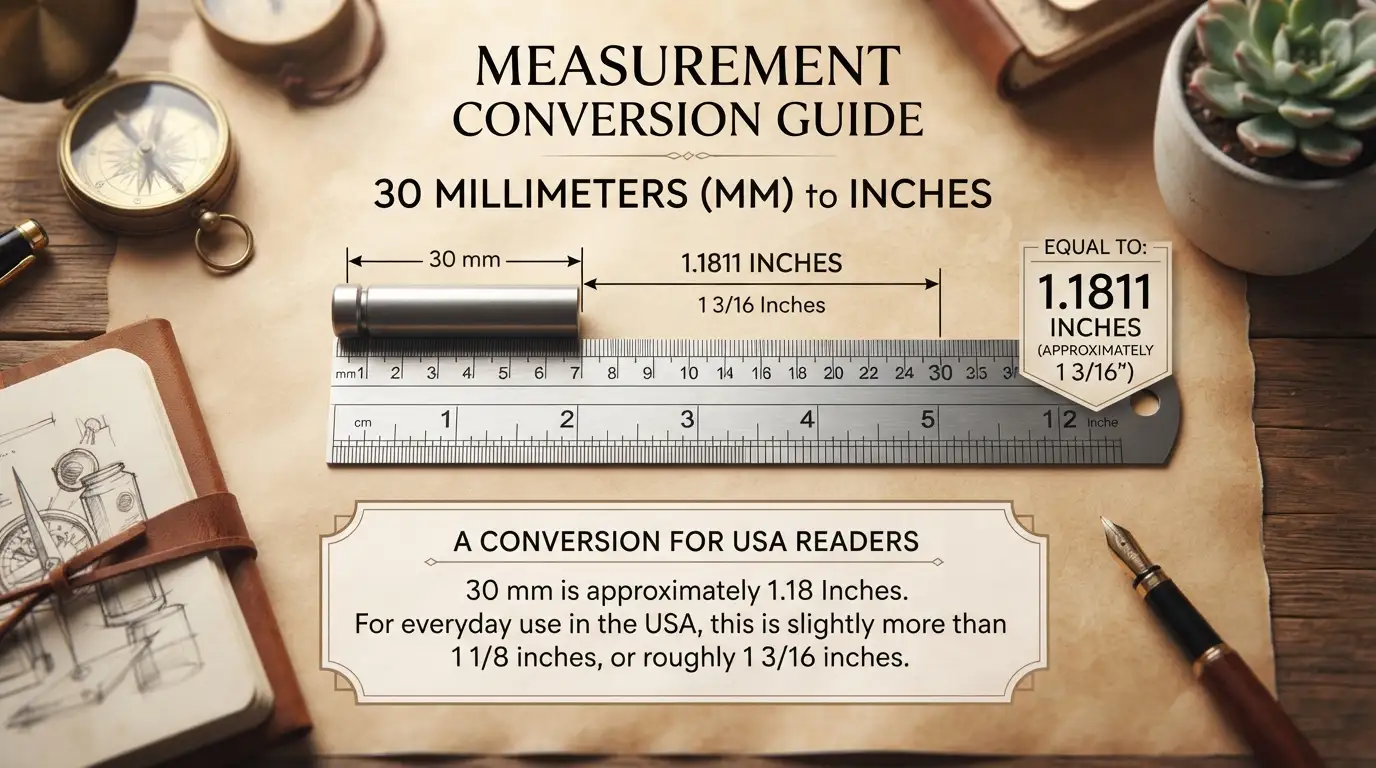

30 millimeters equals 1.1811 inches, or approximately 1 3/16 inches.
If you are measuring something with a ruler, working on a DIY project, or converting metric measurements into US customary units, 30 mm is slightly longer than 1 1/8 inches and just a little shorter than 1 1/4 inches.
The exact conversion is:
- 30 mm = 1.181102 inches
- 30 mm ≈ 1.18 inches
- 30 mm ≈ 1 3/16 inches
- 30 mm = 3 centimeters
This guide explains how to convert 30 millimeters to inches, find the measurement on a ruler, understand its fractional equivalent, and compare it with other common measurements.
How Many Inches Is 30 Millimeters?
30 millimeters is equal to approximately 1.1811 inches.
To understand this measurement, remember that one inch contains exactly 25.4 millimeters. Therefore, 30 millimeters is slightly more than one inch.
Here is the conversion in different formats:
| Measurement format | Result |
| Millimeters | 30 mm |
| Inches (exact calculation) | 1.1811023622 inches |
| Inches (rounded to 4 decimals) | 1.1811 inches |
| Inches (rounded to 2 decimals) | 1.18 inches |
| Fractional inches (approximate) | 1 3/16 inches |
| Centimeters | 3 cm |
If you only need a quick answer, use 1.18 inches. If you need a fraction for a ruler or measuring tape, use approximately 1 3/16 inches.
How to Convert 30 Millimeters to Inches
You can convert millimeters to inches by dividing the millimeter measurement by 25.4.
The conversion formula is:
Inches=Millimeters25.4
For 30 millimeters, the calculation is:
3025.4=1.1811023622
Therefore:
\[ \boxed{30\text{ mm}=1.1811\text{ inches}} \]
This formula works for any millimeter measurement. Simply replace 30 with the number you want to convert.
For example, if you want to convert 40 mm to inches, divide 40 by 25.4. The result is approximately 1.5748 inches.
What Is 30 mm in Inches as a Fraction?
30 mm is approximately 1 3/16 inches when expressed as a common fractional measurement.
The decimal result is 1.1811 inches. To find a practical fraction, compare this value with common fractions used on standard measuring tapes and rulers.
| Fraction | Decimal equivalent |
| 1 1/8 inches | 1.125 |
| 1 3/16 inches | 1.1875 |
| 1 1/4 inches | 1.25 |
| 1 5/16 inches | 1.3125 |
The closest fraction in this list is 1 3/16 inches.
However, remember that 1 3/16 inches is an approximation, not the exact mathematical conversion. It equals 30.1625 mm, which is 0.1625 mm longer than 30 mm.
For precise work, use 1.1811 inches rather than the rounded fraction.
Where Is 30 mm on a Ruler?
To find 30 millimeters on a ruler, look for the 3-centimeter mark on the metric side.
Since 10 millimeters make 1 centimeter:
3010=3cm
Therefore, 30 mm is exactly 3 cm.
On a ruler that displays both metric and inch measurements, the 30 mm mark is located at approximately 1.1811 inches.
Here is how to identify the measurement:
- Find the zero mark on the metric side of your ruler.
- Count 30 small millimeter divisions, or move directly to the 3 cm mark.
- Look at the corresponding position on the inch scale.
- You will find it slightly past 1 1/8 inches and close to 1 3/16 inches.
Is 30 mm exactly 1 3/16 inches on a ruler?
No. It is a close approximation. The exact value is 1.1811 inches, while 1 3/16 inches equals 1.1875 inches.
For ordinary measuring tasks, the fractional value is usually convenient. For precision work, use the decimal measurement.

How Big Is 30 Millimeters?
A measurement of 30 millimeters is equal to 3 centimeters or approximately 1.18 inches.
You can picture this length as a little longer than one inch. It is also a useful measurement to understand when working with small household objects, hardware, tools, and craft materials.
Here are some useful ways to understand its size:
- It is 3 centimeters long.
- It is 0.1 of a meter.
- It is slightly longer than one inch.
- It is approximately 1 3/16 inches.
- It is shorter than 1 1/4 inches.
The actual size of an object measuring 30 mm depends on its shape and dimensions. For example, a 30 mm diameter describes the distance across a circular object, while a 30 mm length describes its measurement from one end to the other.
30 mm to cm to Inches
If you want to convert 30 mm to both centimeters and inches, you can use two simple calculations.
Millimeters to centimeters:
Divide the millimeter value by 10.
3010=3cm
Centimeters to inches:
Divide the centimeter value by 2.54.
32.54=1.1811023622
The final results are:
| Unit | Conversion |
| Millimeters | 30 mm |
| Centimeters | 3 cm |
| Inches | 1.1811 in |
| Fractional inches | Approximately 1 3/16 in |
This means 30 mm, 3 cm, and 1.1811 inches all describe the same length.
Millimeters to Inches Conversion Chart
A conversion chart helps you compare different millimeter measurements without calculating each value individually.
The following table includes 30 mm and several nearby measurements that may be useful when working with rulers, measuring tapes, and other tools.
| Millimeters (mm) | Inches (decimal) | Approximate fraction |
| 25 mm | 0.9843 in | 31/32 in |
| 30 mm | 1.1811 in | 1 3/16 in |
| 32 mm | 1.2598 in | 1 1/4 in |
| 40 mm | 1.5748 in | 1 37/64 in |
| 50 mm | 1.9685 in | 1 31/32 in |
These decimal values are calculated using the standard conversion factor of 25.4 millimeters per inch. Fractional values are approximations to commonly used fractions.
30 mm Compared With Other Common Measurements
If you are comparing 30 mm with other metric measurements, it helps to understand how much the values differ.
Here are some common conversions:
| Measurement | Inches |
| 25 mm to inches | 0.9843 in |
| 30 mm to inches | 1.1811 in |
| 32 mm to inches | 1.2598 in |
| 40 mm to inches | 1.5748 in |
| 50 mm to inches | 1.9685 in |
25 mm to Inches
25 millimeters equals approximately 0.9843 inches.
It is slightly shorter than one inch. Compared with 30 mm, it is 5 mm shorter.
32 mm to Inches
32 millimeters equals approximately 1.2598 inches.
This is close to 1 1/4 inches. It is 2 mm longer than 30 mm.
40 mm to Inches
40 millimeters equals approximately 1.5748 inches.
It is longer than 30 mm by 10 mm and is approximately 1.57 inches.
50 mm to Inches
50 millimeters equals approximately 1.9685 inches.
It is almost 2 inches and is 20 mm longer than 30 mm.
How to Convert Inches Back to Millimeters
You can also reverse the conversion if you have an inch measurement and want to find its equivalent in millimeters.
The formula is:
Millimeters=Inches25.4
For example, to convert 30 inches to millimeters:
3025.4=762mm
Therefore, 30 inches equals 762 millimeters.
Be careful not to confuse 30 inches with 30 millimeters. They are very different lengths.
- 30 mm = 1.1811 inches.
- 30 inches = 762 mm.
Larger Millimeter Measurements Converted to Inches
The same conversion formula works for larger measurements. You only need to divide the millimeter value by 25.4.
Here are a few additional examples:
| Millimeters | Inches |
| 300 mm | 11.8110 in |
| 302 mm | 11.8898 in |
| 303 mm | 11.9291 in |
| 304 mm | 11.9685 in |
| 305 mm | 12.0079 in |
| 306 mm | 12.0472 in |
| 307 mm | 12.0866 in |
| 309 mm | 12.1654 in |
| 3,000 mm | 118.1102 in |
These conversions can be helpful when comparing metric dimensions with measurements commonly used in the United States.
For instance, 304 mm is approximately 11.97 inches, while 305 mm is approximately 12.01 inches. The difference is small, but it can matter when measuring materials or checking product dimensions.
Why Is 25.4 Used to Convert Millimeters to Inches?
The number 25.4 is the standard conversion factor because one international inch is defined as exactly 25.4 millimeters.
This relationship makes metric-to-inch conversions straightforward.
You can use the following rules:
- To convert millimeters to inches, divide by 25.4.
- To convert inches to millimeters, multiply by 25.4.
- To convert millimeters to centimeters, divide by 10.
- To convert centimeters to inches, divide by 2.54.
For example:
5025.4=1.9685inches
And:
225.4=50.8mm
Once you understand these basic calculations, you can convert almost any measurement between millimeters, centimeters, and inches.
Common Uses of a 30 mm Measurement
A 30 mm measurement can appear in different products, materials, and technical specifications.
Some examples include:
- DIY projects: Measuring small spaces, wooden pieces, and craft materials.
- Woodworking: Checking the dimensions of small components and fittings.
- Engineering: Reading technical drawings that use metric dimensions.
- Hardware: Comparing the size of certain parts, fasteners, and fittings.
- Everyday measuring: Checking the length, width, or diameter of small objects.
Always check whether a measurement refers to length, width, height, thickness, or diameter. A 30 mm diameter and a 30 mm length are not necessarily describing the same physical dimension.
For accurate results, use a suitable measuring instrument and avoid relying only on rounded fractions when the dimensions need to be precise.
Frequently Asked Questions
1. How many inches is 30 millimeters?
30 millimeters equals 1.1811 inches. Rounded to two decimal places, it is 1.18 inches.
2. What is 30 mm in inches as a fraction?
30 mm is approximately 1 3/16 inches. This is the closest common fractional measurement, although the exact conversion is 1.1811 inches.
3. Is 30 mm the same as 1 inch?
No. One inch equals exactly 25.4 mm. Therefore, 30 mm is approximately 0.1811 inches longer than one inch.
4. How do you measure 30 mm on a ruler?
Find the 3 cm mark on the metric side of your ruler. Since 1 cm equals 10 mm, the 3 cm mark represents exactly 30 mm.
5. Is 30 mm bigger than 1 1/8 inches?
Yes. One 1/8 inches equals 1.125 inches, while 30 mm equals approximately 1.1811 inches.
The difference is approximately 0.0561 inches.
6. Is 30 mm close to 1 1/4 inches?
It is reasonably close, but 1 1/4 inches is longer. One 1/4 inches equals 31.75 mm, which is 1.75 mm more than 30 mm.
7. How many centimeters are in 30 mm?
30 millimeters equals exactly 3 centimeters.
To convert millimeters into centimeters, divide the measurement by 10.
8. How do you convert 30 mm to inches without a calculator?
Divide 30 by 25.4 to get approximately 1.1811 inches.
For a quick estimate, remember that 25.4 mm is one inch. Since 30 mm is a little more than 25.4 mm, the answer must be slightly greater than one inch.
9. What is 30.5 mm in inches?
30.5 millimeters equals approximately 1.2008 inches.
Use the same conversion formula:
30.525.4=1.2008
10. What is the difference between 30 mm and 30 inches?
30 mm equals approximately 1.1811 inches, while 30 inches equals 762 mm.
The two measurements use different units and represent very different lengths.
Final Answer: 30 Millimeters to Inches
30 millimeters equals 1.1811 inches, which is approximately 1 3/16 inches or exactly 3 centimeters.
For quick conversions, remember that you can divide any millimeter measurement by 25.4 to get inches. This method works for small measurements such as 30 mm and larger measurements such as 300 mm or 3,000 mm.
Whether you are using a ruler, measuring materials, completing a DIY project, or checking technical dimensions, understanding both decimal and fractional inches makes metric conversions easier.


Hannah Fleming writes role overviews for healthcare, education and community-focused jobs. She breaks down daily tasks, skills and typical requirements in plain language, so readers can see what a role involves before they apply.