

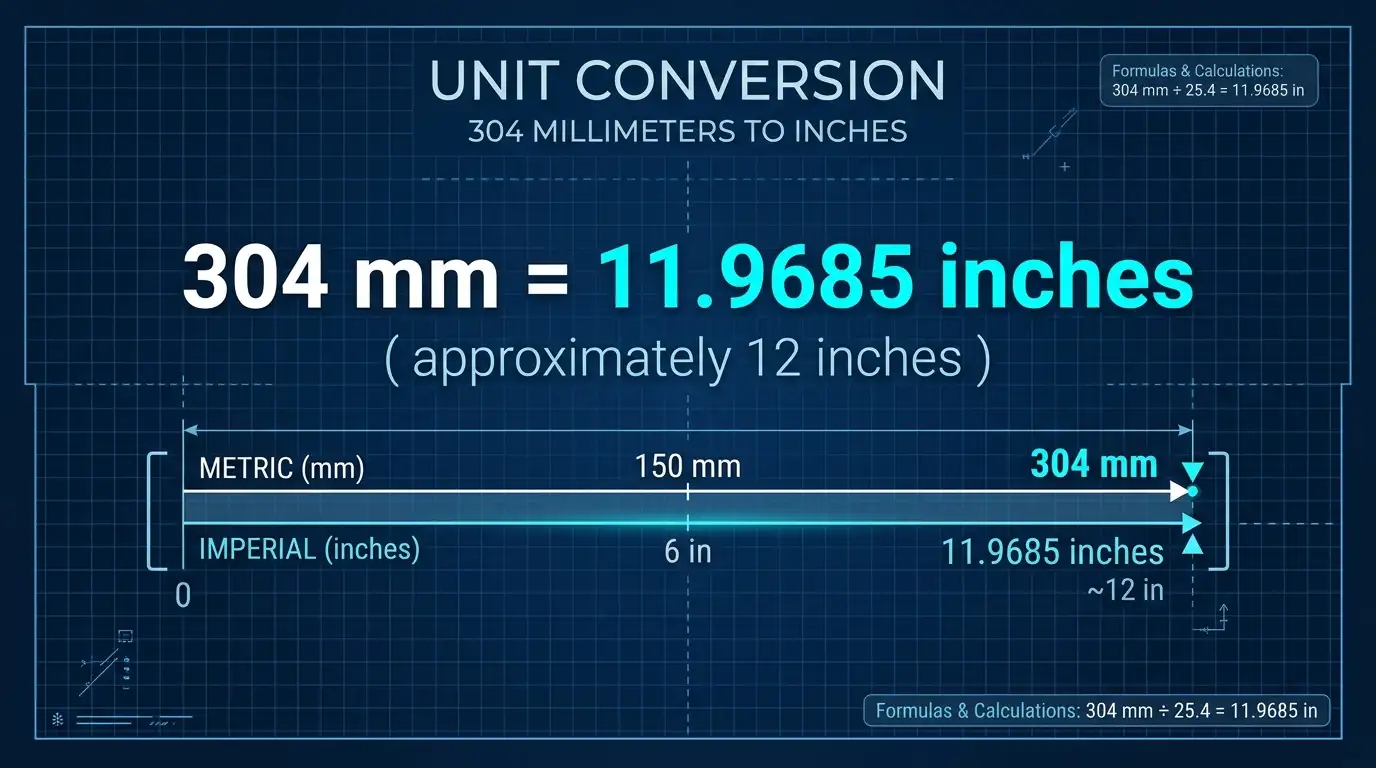
304 millimeters (mm) is equal to 11.9685 inches, or approximately 11.97 inches. In fraction form, 304 mm is approximately 11 31/32 inches.
To convert millimeters to inches, divide the millimeter measurement by 25.4. This guide explains the exact conversion, decimal result, fractional equivalent, feet conversion, and related measurements.

How Many Inches Is 304 mm?
304 mm equals 11.968503937 inches.
Here are the most useful representations:
| Measurement | Result |
| Millimeters | 304 mm |
| Exact decimal conversion | 11.968503937 inches |
| Rounded to 2 decimal places | 11.97 inches |
| Rounded to 3 decimal places | 11.969 inches |
| Fractional inches (nearest 1/32) | 11 31/32 inches |
| Feet | 0.998688 feet |
| Feet and inches | Approximately 0 feet 11.97 inches |
The decimal value is useful for calculators, engineering measurements, and precise calculations. The fractional value is helpful when using rulers, tape measures, and other measuring tools.
How to Convert 304 mm to Inches
You can convert 304 millimeters to inches by dividing 304 by 25.4.
Conversion formula:
\[ \text{Inches}=\frac{\text{Millimeters}}{25.4} \]
Put 304 into the formula:
\[ 304\div25.4=11.968503937 \]
Therefore:
\[ \boxed{304\text{ mm}=11.968503937\text{ inches}} \]
For everyday measurements, you can round the answer to 11.97 inches.
What Is 304 mm in Fractional Inches?
304 mm is approximately 11 31/32 inches when rounded to the nearest 1/32 inch.
To understand this conversion:
- First, convert 304 mm into decimal inches.
- The result is 11.968503937 inches.
- Separate the whole number (11) from the decimal part (0.968503937).
- Multiply the decimal part by 32.
\[ 0.968503937\times32=30.9921 \]
Round 30.9921 to 31.
The resulting fraction is:
\[ 11+\frac{31}{32}=11\frac{31}{32} \]
This means 304 mm is approximately 11 31/32 inches.
304 mm to Inches and Feet
304 millimeters is slightly less than one foot.
Since one foot contains 12 inches, you can convert 304 mm into feet by first converting it to inches and then dividing by 12.
Step 1: Convert millimeters to inches.
\[ 304\div25.4=11.968503937 \]
Step 2: Convert inches to feet.
\[ 11.968503937\div12=0.997375328 \]
Therefore:
- 304 mm = 0.997375 feet
- 304 mm = 11.9685 inches
- 304 mm = approximately 0 feet and 11.97 inches
This measurement is just 0.0315 inches shorter than a full foot.
Conversion Chart
The following chart shows how 304 mm compares with nearby measurements. It also includes fractional-inch equivalents for people using standard measuring tools.
| Millimeters (mm) | Decimal Inches | Approximate Fraction |
| 300 mm | 11.8110 | 11 13/16 |
| 301 mm | 11.8504 | 11 27/32 |
| 302 mm | 11.8898 | 11 7/8 |
| 303 mm | 11.9291 | 11 15/16 |
| 304 mm | 11.9685 | 11 31/32 |
| 305 mm | 12.0079 | 12 |
| 306 mm | 12.0472 | 12 1/16 |
| 307 mm | 12.0866 | 12 3/32 |
| 308 mm | 12.1260 | 12 1/8 |
| 309 mm | 12.1654 | 12 5/32 |
| 310 mm | 12.2047 | 12 7/32 |
| 320 mm | 12.5984 | 12 19/32 |
| 330 mm | 12.9921 | 13 |
Fractional values are rounded to the nearest 1/32 inch.

304 mm vs. 304.8 mm to Inches
304 mm and 304.8 mm are different measurements, even though their numbers look almost identical.
The difference is important because 304.8 mm is exactly equal to 12 inches, while 304 mm is slightly shorter.
| Millimeters | Inches |
| 304 mm | 11.968503937 |
| 304.4 mm | 11.984251969 |
| 304.5 mm | 11.988188976 |
| 304.6 mm | 11.992125984 |
| 304.7 mm | 11.996062992 |
| 304.8 mm | 12 |
| 304.9 mm | 12.003937008 |
| 304.80 mm | 12 |
| 304.800 mm | 12 |
Why does 304.8 mm equal 12 inches?
The international inch is defined as exactly 25.4 millimeters.
Since one foot contains 12 inches:
\[ 12\times25.4=304.8\text{ mm} \]
Therefore, 304.8 mm is exactly one foot.
This distinction is useful when measuring construction materials, furniture, pipes, and other objects where small differences matter.
Other Common Millimeter-to-Inch Conversions
If you are converting nearby measurements, the following results may help.
| Millimeters | Inches |
| 100 mm | 3.9370 inches |
| 200 mm | 7.8740 inches |
| 250 mm | 9.8425 inches |
| 300 mm | 11.8110 inches |
| 304 mm | 11.9685 inches |
| 305 mm | 12.0079 inches |
| 330 mm | 12.9921 inches |
| 350 mm | 13.7795 inches |
| 400 mm | 15.7480 inches |
| 500 mm | 19.6850 inches |
| 1,000 mm | 39.3701 inches |
| 3,040 mm | 119.6850 inches |
| 3,042 mm | 119.7638 inches |
These conversions use the standard relationship of 25.4 millimeters per inch.
How to Convert Different Measurements from mm to Inches
Sometimes, you may need to convert more than one dimension. For example, a product specification might list its length, width, and height in millimeters.
The same conversion formula works for every dimension.
Consider a product with measurements of 479 × 304 × 376 mm.
Convert each measurement separately:
| Original Measurement | Calculation | Inches |
| 479 mm | 479 ÷ 25.4 | 18.8583 |
| 304 mm | 304 ÷ 25.4 | 11.9685 |
| 376 mm | 376 ÷ 25.4 | 14.8031 |
The converted dimensions are approximately:
18.86 × 11.97 × 14.80 inches.
You can use the same method for measurements such as:
- 304 × 126 × 50 mm = 11.97 × 4.96 × 1.97 inches.
- 425 × 304 × 154 mm = 16.73 × 11.97 × 6.06 inches.
Always convert each dimension individually. Do not add the measurements together unless you specifically need their combined length.

Why Do We Divide Millimeters by 25.4?
Millimeters and inches are units of length used in different measurement systems.
The millimeter belongs to the metric system, while the inch belongs to the US customary and imperial measurement systems.
One inch is exactly 25.4 millimeters. This is why division by 25.4 converts a millimeter measurement into inches.
For example:
- 25.4 mm = 1 inch
- 50.8 mm = 2 inches
- 76.2 mm = 3 inches
- 101.6 mm = 4 inches
- 127 mm = 5 inches
- 254 mm = 10 inches
- 304.8 mm = 12 inches
You can also reverse the calculation. Multiply inches by 25.4 to get millimeters.
Practical Examples
Understanding the numerical conversion is easier when you know where the measurement might be useful.
1. Construction and home improvement
If a construction plan specifies a 304 mm measurement, you can use approximately 11.97 inches when working with inch-based tools. For accurate cutting or fitting, use the unrounded conversion where necessary.
2. Furniture and storage
Furniture dimensions are often listed in millimeters. Converting 304 mm to approximately 11.97 inches can make it easier to compare product specifications with available space.
3. Engineering and manufacturing
Engineers and manufacturers may work with both metric and inch-based measurements. The precise value of 11.968503937 inches is more appropriate than the rounded value when tolerances are important.
4. Measuring with a tape measure
If you are using a standard US tape measure, 304 mm is very close to 11 31/32 inches. However, the exact position may depend on the measuring tool’s markings and accuracy.
Frequently Asked Questions
1. How many inches
304 millimeters equals 11.968503937 inches. Rounded to two decimal places, it is 11.97 inches.
2. What is 304 mm in inches as a fraction?
304 mm is approximately 11 31/32 inches when rounded to the nearest 1/32 inch.
3. Is 304 mm the same as 12 inches?
No. 304 mm equals approximately 11.9685 inches. Exactly 12 inches equals 304.8 mm, making it 0.8 mm longer than 304 mm.
4. How many feet
304 mm equals approximately 0.997375 feet. It is just under one foot.
5. How do I convert 304 mm to inches?
Divide 304 by 25.4.
\[ 304\div25.4=11.968503937 \]
The answer is approximately 11.97 inches.
6. What is 304.8 mm in inches?
304.8 mm equals exactly 12 inches, which is also one foot.
7. How many inches is 305 mm?
305 mm equals approximately 12.0079 inches. Rounded to two decimal places, it is 12.01 inches.
8. How many inches is 330 mm?
330 mm equals approximately 12.9921 inches, or about 12.99 inches.
9. How many inches is 400 mm?
400 mm equals approximately 15.748 inches. Rounded to two decimal places, it is 15.75 inches.
10. How many inches is 100 mm?
100 mm equals approximately 3.937 inches, or 3.94 inches when rounded to two decimal places.
11. How many millimeters are in 17 inches?
One inch equals 25.4 mm. Therefore:
\[ 17\times25.4=431.8\text{ mm} \]
So, 17 inches equals 431.8 millimeters.
12. How many inches is 320 mm?
320 mm equals approximately 12.5984 inches, or 12.60 inches when rounded to two decimal places.
Final Answer
304 mm = 11.968503937 inches = approximately 11.97 inches.
If you need a fractional measurement, use approximately 11 31/32 inches. If you need the measurement in feet, 304 mm is approximately 0.997375 feet.
For the most accurate results, divide millimeters by 25.4 and avoid rounding until the final step.

Hannah Fleming writes role overviews for healthcare, education and community-focused jobs. She breaks down daily tasks, skills and typical requirements in plain language, so readers can see what a role involves before they apply.