

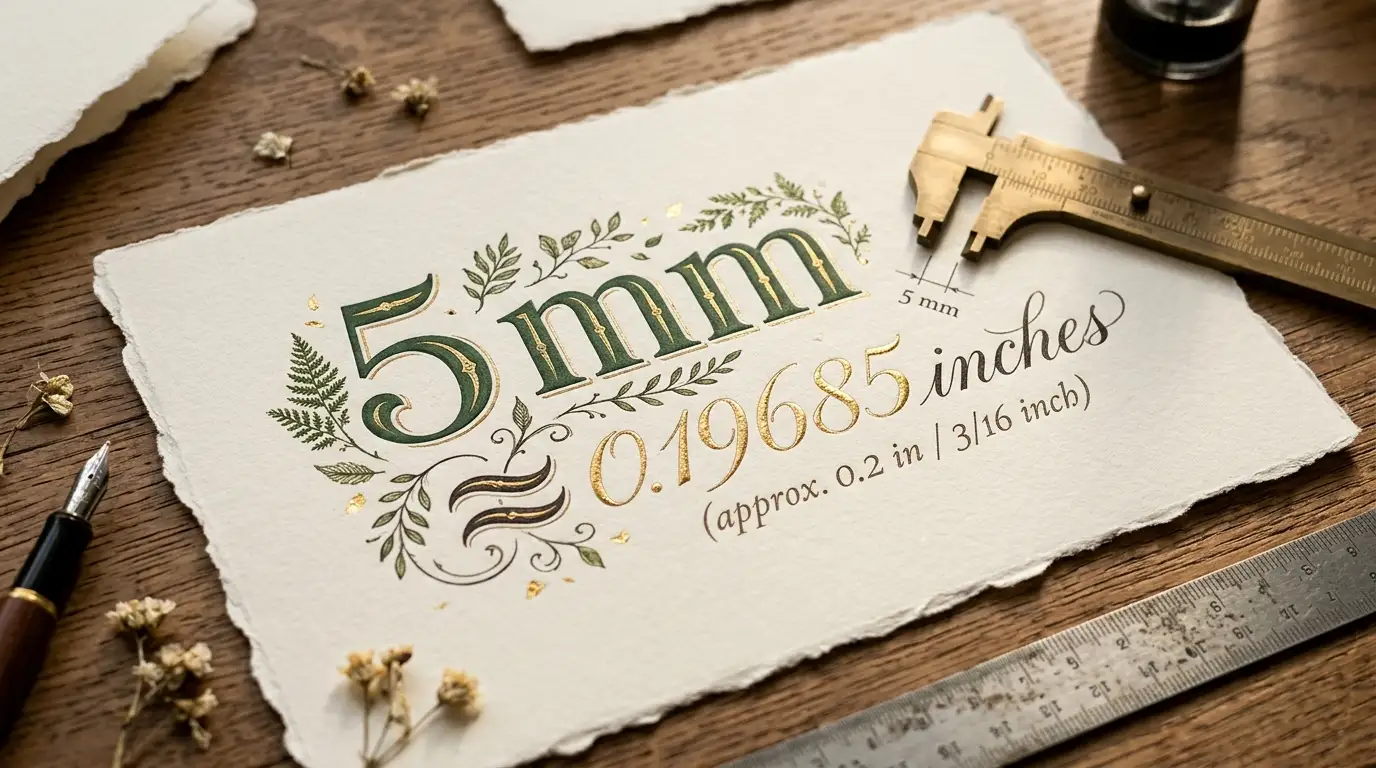
5 mm equals 0.19685 inches, or approximately 0.197 inches. As a fraction, 5 mm is closest to 3/16 inch on a standard inch ruler or tape measure.
To convert 5 mm to inches, divide 5 by 25.4:
\[ 5 \div 25.4 = 0.1968503937 \]
This guide explains the exact conversion, its fractional equivalent, how to find 5 mm on a tape measure, and how to convert other millimeter measurements into inches, centimeters, and feet.

How Many Inches Is 5 mm?
Five millimeters is equal to approximately 0.1969 inches.
Here is the conversion in different formats:
| Measurement format | Equivalent |
| Millimeters | 5 mm |
| Decimal inches | 0.19685 inches |
| Rounded to 3 decimal places | 0.197 inches |
| Rounded to 2 decimal places | 0.20 inches |
| Fractional inches (nearest 1/16) | 3/16 inch |
| Centimeters | 0.5 cm |
| Feet | 0.0164 feet |
The exact decimal value is approximately 0.1968503937 inches. You can use 0.197 inches for most everyday measurements.
5 mm to Inches Fraction
If you work with rulers, tape measures, woodworking tools, or hardware, you may prefer fractions instead of decimal measurements.
Five millimeters is approximately 3/16 inch when rounded to the nearest 1/16 inch.
Here is how the comparison works:
- 5 mm = 0.19685 inches.
- 3/16 inch = 0.1875 inches.
- The difference is approximately 0.00935 inches.
This means 3/16 inch is the closest common 1/16-inch measurement.
However, 5 mm is not exactly equal to 3/16 inch. The metric measurement is slightly larger.
Is 5 mm the Same as 3/16 Inch?
No. These measurements are close, but they are not identical.
- 5 mm = 0.19685 inches.
- 3/16 inch = 4.7625 mm.
The difference is about 0.2375 mm.
For rough measurements, 3/16 inch is a useful approximation. For accurate engineering, manufacturing, or fitting work, use the actual 5 mm measurement.
Where Is 5 mm on a Tape Measure?
To find 5 mm on an inch tape measure, look for the 3/16-inch mark.
Since 5 mm equals approximately 0.197 inches, it falls slightly beyond the 3/16-inch mark.
Follow these steps:
- Find the zero mark on your tape measure.
- Look at the first inch section.
- Find the 3/16-inch marking.
- Remember that the actual 5 mm position is slightly farther along than this mark.
Most standard inch tape measures do not show an exact 5 mm marking. Therefore, 3/16 inch is a convenient reference rather than an exact replacement.
If you need precise measurements, use a metric ruler or digital caliper.
How to Convert 5 mm to Inches
The conversion from millimeters to inches uses a fixed relationship:
1 inch = 25.4 millimeters
To convert millimeters into inches, divide the millimeter value by 25.4.
The formula is:
\[ \text{Inches}=\frac{\text{Millimeters}}{25.4} \]
For 5 mm:
\[ \text{Inches}=\frac{5}{25.4} \]
\[ =0.1968503937 \]
Therefore:
5 mm = 0.19685 inches.
You can use this formula for any millimeter measurement.
5 mm to Inches Rounded to 3 Decimal Places
When you need a shorter and easier number, you can round 5 mm to three decimal places.
The exact conversion is:
\[ 5 \div 25.4 = 0.1968503937 \]
To round this number to three decimal places:
- Keep the first three digits after the decimal point: 196.
- Look at the fourth decimal digit, which is 8.
- Since 8 is greater than 5, increase the third decimal digit by one.
The result is:
\[ \boxed{5\text{ mm}=0.197\text{ inches}} \]
This rounded value is suitable for many everyday calculations. However, use the unrounded value when greater accuracy is necessary.
5 mm to Centimeters
Five millimeters is equal to 0.5 centimeters.
Since 10 millimeters make 1 centimeter, divide 5 by 10.
\[ 5 \div 10=0.5 \]
Therefore:
5 mm = 0.5 cm
This conversion is useful when comparing metric measurements or working with a ruler that displays centimeters instead of millimeters.

Millimeters to Inches and Feet
Millimeters can be converted into both inches and feet. The calculation depends on which unit you need.
Use these conversion relationships:
- 1 inch = 25.4 mm
- 1 foot = 304.8 mm
- 1 foot = 12 inches
For inches, divide the millimeter measurement by 25.4.
feet, divide the millimeter measurement by 304.8.
For example, converting 5 mm into feet:
\[ 5 \div 304.8=0.0164042 \]
Therefore:
5 mm = 0.0164 feet.
Feet are generally more useful for larger measurements, while inches are more convenient for smaller objects.
10 mm and 50 mm to Inches
If you are comparing 5 mm with other common metric measurements, the following conversions may help.
| Millimeters | Inches (decimal) | Nearest 1/16 inch |
| 5 mm | 0.19685 | 3/16 |
| 10 mm | 0.39370 | 3/8 |
| 50 mm | 1.96850 | 2 inches (nearest whole inch) |
10 mm to Inches
To convert 10 mm into inches:
\[ 10 \div 25.4=0.3937007874 \]
Therefore, 10 mm equals approximately 0.3937 inches or 0.394 inches when rounded to three decimal places.
50 mm to Inches
To convert 50 mm into inches:
\[ 50 \div 25.4=1.968503937 \]
Therefore, 50 mm equals approximately 1.9685 inches.
It is also close to 2 inches, but it is slightly smaller.
Understanding Different 5 mm Conversion Searches
People may search for different versions of the same conversion because they need different levels of detail.
Here are some common questions and what their answers mean.
Convert 5 mm to inches: The answer is 0.19685 inches.
Convert 5 mm to inches fraction: The nearest 1/16-inch fraction is 3/16 inch.
Google convert 5 mm to inches: A conversion calculator can provide the decimal result by dividing 5 by 25.4.
Please convert 5 mm to inches: The result remains 0.19685 inches, regardless of how the question is phrased.
5 mm converted to inches: This is another way of asking for the same decimal conversion.
Convert 5 mm to inches round to 3 dp: The answer is 0.197 inches.
These searches have the same main conversion intent. The difference is that some users want a fraction, while others need a rounded decimal result.
Converting Inches Back to Millimeters
Sometimes you may have a measurement in inches and need to convert it into millimeters.
For this calculation, multiply the inch measurement by 25.4.
The formula is:
\[ \text{Millimeters}=\text{Inches}\times25.4 \]
Here are some useful examples:
| Inches | Millimeters |
| 5/8 inch | 15.875 mm |
| 5/16 inch | 7.9375 mm |
| 2 5/8 inches | 66.675 mm |
| 1 5/8 inches | 41.275 mm |
| 5 1/2 inches | 139.7 mm |
For example, to convert 5/16 inches into millimeters:
First, convert the fraction into a decimal:
\[ 5\div16=0.3125 \]
Then multiply by 25.4:
\[ 0.3125\times25.4=7.9375 \]
Therefore, 5/16 inches equals 7.9375 mm.
The same method works for mixed fractions. Convert the whole number and fraction into a decimal first, then multiply by 25.4.

What Does 4–5 mm Mean in Inches?
A measurement written as 4–5 mm represents a range rather than one exact value.
To convert both ends of the range:
- 4 mm ÷ 25.4 = 0.15748 inches.
- 5 mm ÷ 25.4 = 0.19685 inches.
Therefore:
4–5 mm = approximately 0.1575–0.1969 inches.
This type of measurement can be useful when describing the approximate thickness or size of an object.
Is 5 mm a Standard Inch Measurement?
Five millimeters does not have an exact equivalent in common fractional-inch measurements.
Its closest 1/16-inch equivalent is 3/16 inch.
However, the closest fraction can change depending on the ruler or measuring system you use.
| Fraction | Decimal inches | Millimeters |
| 1/8 inch | 0.125 | 3.175 |
| 3/16 inch | 0.1875 | 4.7625 |
| 1/4 inch | 0.25 | 6.35 |
| 5/16 inch | 0.3125 | 7.9375 |
As you can see, 3/16 inch is the closest measurement to 5 mm in this table.
For exact work, do not treat the two measurements as interchangeable.
Quick Millimeter to Inches Conversion Chart
The following chart provides several useful conversions for quick reference.
| Millimeters | Inches |
| 1 mm | 0.03937 |
| 2 mm | 0.07874 |
| 3 mm | 0.11811 |
| 4 mm | 0.15748 |
| 5 mm | 0.19685 |
| 6 mm | 0.23622 |
| 7 mm | 0.27559 |
| 8 mm | 0.31496 |
| 9 mm | 0.35433 |
| 10 mm | 0.39370 |
| 15 mm | 0.59055 |
| 20 mm | 0.78740 |
| 25 mm | 0.98425 |
| 30 mm | 1.18110 |
| 40 mm | 1.57480 |
| 50 mm | 1.96850 |
All values are rounded to five decimal places.
This chart can help when you need to compare nearby measurements without repeating the same calculation.
When Is the 5 mm to Inches Conversion Useful?
A 5 mm measurement is common in different types of everyday and technical work.
Here are a few situations where converting it into inches can be helpful.
1. Measuring small objects
If an object is listed as 5 mm in a metric specification but your ruler uses inches, the decimal conversion helps you understand its approximate size.
2. Working with drill bits
Drill bit sizes may be listed in millimeters or fractional inches. Knowing that 5 mm is approximately 0.197 inches helps you compare metric and imperial sizes. Remember that a 3/16-inch drill bit is close but not identical.
3. Hardware and small fittings
Screws, connectors, fittings, and other small components may use metric measurements. Converting 5 mm into inches makes it easier to compare measurements across different specifications.
4. DIY and home improvement
If you use an imperial tape measure for a project involving metric dimensions, knowing the nearest fractional-inch measurement can help with rough estimates.
5. Engineering and manufacturing
Accurate conversion is important when working with technical drawings, machine parts, and product dimensions. In these situations, use the full decimal value rather than replacing 5 mm with an approximate fraction.
Frequently Asked Questions
1. How many inches is exactly 5 mm?
Five millimeters equals approximately 0.1968503937 inches. The commonly rounded value is 0.1969 inches.
2. Is 5 mm equal to 0.2 inches?
Almost. Five millimeters equals 0.19685 inches, which rounds to 0.20 inches when using two decimal places.
3. What fraction of an inch is 5 mm?
Five millimeters is closest to 3/16 inch when rounded to the nearest 1/16 inch. However, these measurements are not exactly equal.
4. Is 5 mm bigger than 3/16 inch?
Yes. Five millimeters equals approximately 0.19685 inches, while 3/16 inch equals 0.1875 inches. Therefore, 5 mm is slightly bigger.
5. How do I convert 5 mm to inches without a calculator?
Divide 5 by 25.4 to get approximately 0.19685 inches. You can also multiply 5 by 0.0393701 to get the same result.
6. How many centimeters are in 5 mm?
Five millimeters equals 0.5 centimeters. Divide the millimeter measurement by 10 to convert it into centimeters.
7. How many feet are in 5 mm?
Five millimeters equals approximately 0.0164 feet. Divide 5 by 304.8 to calculate the result.
8. What is 5 mm rounded to three decimal places?
Five millimeters equals 0.197 inches when rounded to three decimal places.
9. Where can I find 5 mm on a standard inch ruler?
Look for the 3/16-inch mark. It is the closest common 1/16-inch marking, although the actual 5 mm position is slightly beyond it.
10. What is the difference between 5 mm and 5 inches?
They are very different measurements. Five millimeters equals approximately 0.197 inches, while 5 inches equals 127 millimeters.
Final Answer
Five millimeters equals 0.19685 inches, which rounds to 0.197 inches. Its closest common fractional-inch measurement is 3/16 inch.
For quick calculations, divide any millimeter measurement by 25.4 to convert it into inches. If you need an exact result for technical or engineering work, use the unrounded decimal value.

Hannah Fleming writes role overviews for healthcare, education and community-focused jobs. She breaks down daily tasks, skills and typical requirements in plain language, so readers can see what a role involves before they apply.